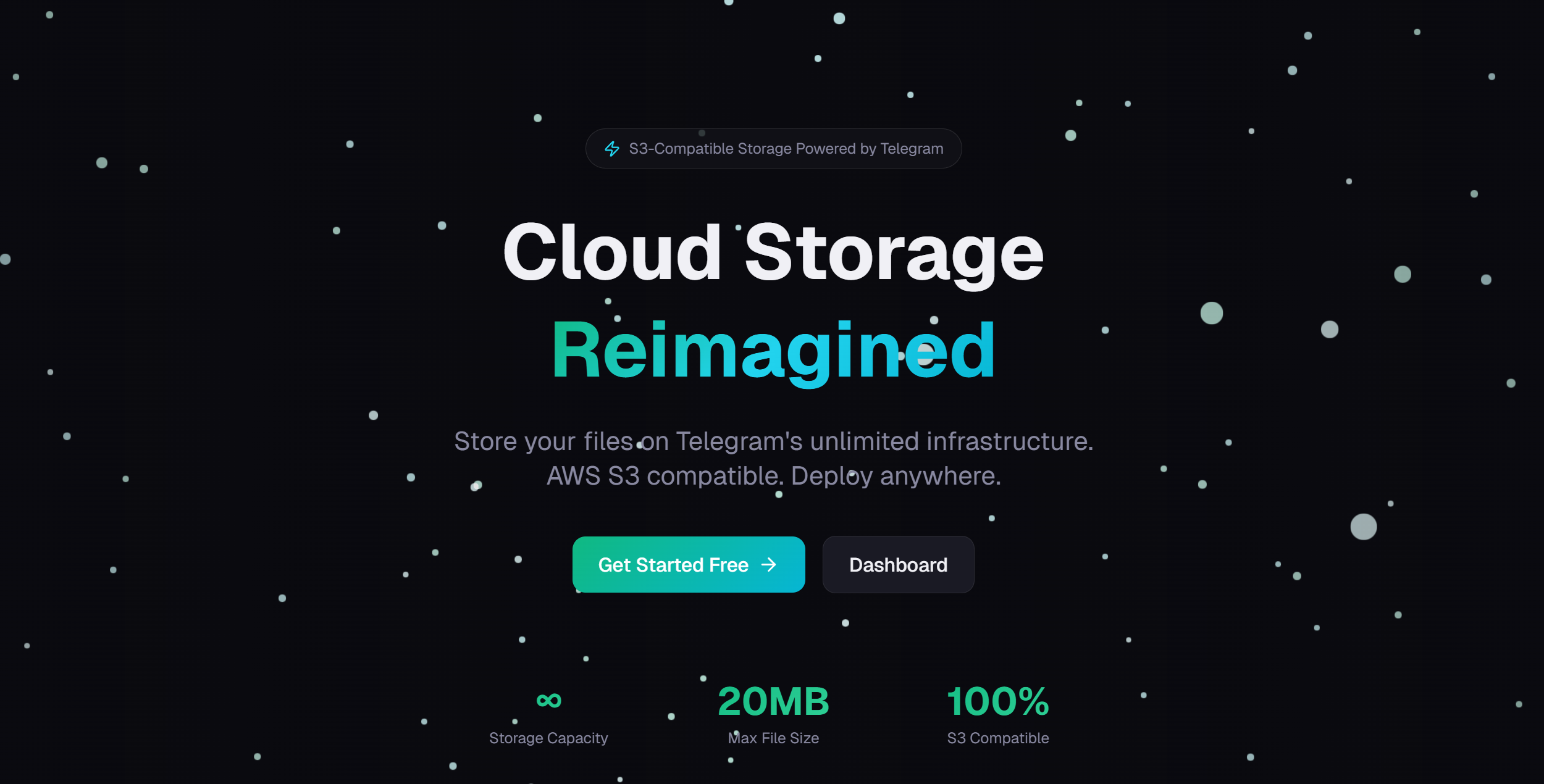
G2 Storage is an experimental cloud storage platform that provides an S3-compatible API powered entirely by Telegram’s cloud infrastructure. The project was built around a simple but unconventional idea: turning Telegram’s free and effectively unlimited file storage capabilities into a usable object storage service similar to Amazon S3.
The system allows developers to interact with Telegram storage using familiar S3 workflows and tooling. Applications can upload, retrieve, and manage files through a standard S3-compatible API, making it possible to integrate G2 Storage with existing SDKs, libraries, backup tools, and storage clients without significant modifications.
Under the hood, uploaded files are transferred through a Telegram bot and stored directly on Telegram’s servers. The platform then manages metadata such as file identifiers, object references, bucket mappings, and retrieval mechanisms to emulate traditional cloud object storage behavior. Features such as buckets, objects, HMAC authentication, and presigned URLs were implemented to provide a developer experience similar to mainstream cloud storage providers.
The project was originally created as a technical experiment driven by curiosity and exploration of unconventional infrastructure possibilities. What started as a late-night “what if” idea evolved into a fully functional storage abstraction layer capable of serving lightweight storage use cases.
G2 Storage is particularly suitable for hobby projects, personal backups, prototypes, internal tools, and non-critical applications where minimizing infrastructure cost is more important than enterprise-grade guarantees. The project demonstrates how alternative platforms and APIs can be creatively repurposed to build functional cloud-like services with minimal operational overhead.
From an engineering perspective, the project focuses heavily on API compatibility, lightweight architecture, and cost-efficient infrastructure experimentation. It also highlights an unconventional approach to storage engineering by leveraging existing platforms in unexpected but technically practical ways.
Although the platform itself is not open source, the project serves as an interesting proof-of-concept showcasing creative backend architecture, API abstraction design, and unconventional cloud infrastructure experimentation.